# Análisis 94: Depósito rígido y aislado con propano

{% hint style="info" %}
En un depósito rígido y bien aislado se encuentra propano y 0.687 kg de aire, a 2 atm y 300 K. La mezcla es combustionada de manera estequiométrica a volumen constante, generándose la reacción de combustión siguiente:

C<sub>3</sub>H<sub>8</sub> + 5 (O<sub>2</sub> +3.76 N<sub>2</sub>) ---> 2.47 CO<sub>2</sub> + 0.53 CO + 18.80 N<sub>2</sub> + 0.33 O<sub>2</sub> + 0.13 H<sub>2</sub> + 3.87 H<sub>2</sub>O

Obtener:

1. Presión alcanzada por los productos de combustión
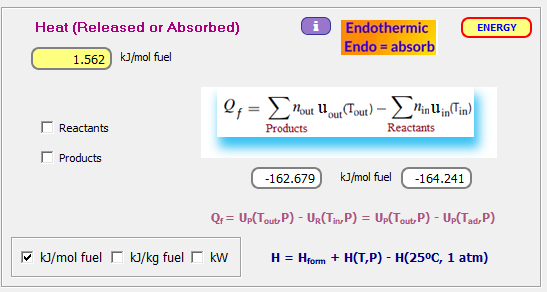
2. Demostrar que la temperatura alcanzada por los productos de combustión de 2445 ºC es consistente con el balance energético
3. Efecto que tendría la disociación química de los productos de combustión

*(Introduction to Internal Combustion Engines de Richard Stone)*
{% endhint %}

![](https://thermosuite.com/manual/94/media/image2.png) ![](https://thermosuite.com/manual/94/media/image3.png)

![](https://thermosuite.com/manual/94/media/image4.png)

![](https://thermosuite.com/manual/94/media/image5.png) ![](https://thermosuite.com/manual/94/media/image6.png)

![](https://thermosuite.com/manual/94/media/image7.png)

![](https://thermosuite.com/manual/94/media/image8.png)

Ajustamos las relaciones CO<sub>2/</sub>CO e H<sub>2</sub>/CO para obtener la estequiometría suministrada por el enunciado del problema.

![](https://thermosuite.com/manual/94/media/image9.png)

![](https://thermosuite.com/manual/94/media/image10.png)

Se comprueba que para una temperatura de los productos de combustión de 2445ºC el proceso reactivo es prácticamente adiabático, h<sub>R</sub> ≈ h<sub>P</sub>.

&#x20;

<figure><img src="https://thermosuite.com/manual/94/media/image11.png" alt=""><figcaption></figcaption></figure>

![](https://thermosuite.com/manual/94/media/image12.png) ![](https://thermosuite.com/manual/94/media/image13.png)

![](https://thermosuite.com/manual/94/media/image14.png)

![](https://thermosuite.com/manual/94/media/image15.png)

![](https://thermosuite.com/manual/94/media/image16.png)

![](https://thermosuite.com/manual/94/media/image17.png)

![](https://thermosuite.com/manual/94/media/image18.png)

![](https://thermosuite.com/manual/94/media/image19.png)

![](https://thermosuite.com/manual/94/media/image20.png) ![](https://thermosuite.com/manual/94/media/image21.png)

![](https://thermosuite.com/manual/94/media/image22.png)

La disociación de los productos de combustión hace disminuir la temperatura adiabática de la llama, ya que son reacciones exotérmicas que consumen energía, decreciendo la \`presión alcanzada por los humos de combustión.

Por otra parte, la temperatura alcanzada es mayor que en una combustión a presión constante, ya que no hay consumo de energía mediante trabajo realizado por los gases calientes en incrementar su volumen contra la presión atmosférica.

---

# Agent Instructions: Querying This Documentation

If you need additional information that is not directly available in this page, you can query the documentation dynamically by asking a question.

Perform an HTTP GET request on the current page URL with the `ask` query parameter:

```
GET https://thermosuite.gitbook.io/thermocombustion-hf/analisis-91-al-100/analisis-94-deposito-rigido-y-aislado-con-propano.md?ask=<question>
```

The question should be specific, self-contained, and written in natural language.
The response will contain a direct answer to the question and relevant excerpts and sources from the documentation.

Use this mechanism when the answer is not explicitly present in the current page, you need clarification or additional context, or you want to retrieve related documentation sections.
