# Análisis 78: Fórmula empírica con inquemados (CO y C2H6)

{% hint style="info" %}
Un combustible líquido C<sub>16.5</sub>H<sub>34.44</sub> es quemado en un horno industrial empleando una mezcla rica, coeficiente de exceso de aire de 0.88451. La relación molar CO<sub>2</sub>/CO=1.8448.

Si el aire y el combustible entran en condiciones estándar (25 ºC, 1 atm), y los productos de la combustión salen a 750 ºC. Obtener:

1. Obtener la composición en base seca y húmeda de los gases de escape
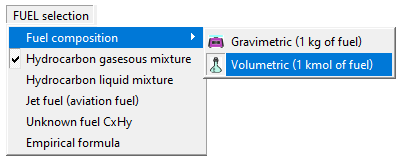
2. El diagrama de Ostwald
3. Temperatura adiabática de la llama
4. Balance de energía
5. Resolver el caso suponiendo que existe hidrocarburos sin quemar en forma de etano (10000 ppm), obteniendo además la entropía generada y el análisis exergético

Datos conocidos:

* Entalpía de formación del combustible de -320 kJ/mol fuel
* Entropía a 1 atm y 25 ºC de 122 J/mol fuel K
  {% endhint %}

![](https://thermosuite.com/manual/78/media/image2.png) ![](https://thermosuite.com/manual/78/media/image3.png)

<figure><img src="/files/l3Usg4jIIYdbElaFMSYp" alt=""><figcaption></figcaption></figure>

![](https://thermosuite.com/manual/78/media/image4.png) ![](https://thermosuite.com/manual/78/media/image5.png) ![](https://thermosuite.com/manual/78/media/image6.png)

![](https://thermosuite.com/manual/78/media/image7.png)

![](https://thermosuite.com/manual/78/media/image8.png)

![](https://thermosuite.com/manual/78/media/image9.png)

![](https://thermosuite.com/manual/78/media/image10.png)

![](https://thermosuite.com/manual/78/media/image11.png)

![](https://thermosuite.com/manual/78/media/image12.png)

![](https://thermosuite.com/manual/78/media/image13.png)

![](https://thermosuite.com/manual/78/media/image14.png)

El diagrama de Ostwald muestra que no hay presencia de O<sub>2</sub> en los productos de combustión.

![](https://thermosuite.com/manual/78/media/image15.png) ![](https://thermosuite.com/manual/78/media/image16.png)

![](https://thermosuite.com/manual/78/media/image17.png)

![](https://thermosuite.com/manual/78/media/image18.png)

![](https://thermosuite.com/manual/78/media/image19.png) ![](https://thermosuite.com/manual/78/media/image20.png)

![](https://thermosuite.com/manual/78/media/image21.png)

![](https://thermosuite.com/manual/78/media/image22.png)

![](https://thermosuite.com/manual/78/media/image23.png)

![](https://thermosuite.com/manual/78/media/image24.png)

![](https://thermosuite.com/manual/78/media/image25.png)

Si suponemos una combustión que genera hidrocarburos sin quemar, en forma de C<sub>2</sub>H<sub>6</sub> (10000 ppm que equivale al 1 %):

![](https://thermosuite.com/manual/78/media/image26.png)

![](https://thermosuite.com/manual/78/media/image27.png)

![](https://thermosuite.com/manual/78/media/image28.png)

![](https://thermosuite.com/manual/78/media/image29.png) ![](https://thermosuite.com/manual/78/media/image30.png)

Como era de esperar la presencia de hidrocarburos sin quemar en los productos de la combustión hace decrecer ligeramente la temperatura adiabática de la llama.

![](https://thermosuite.com/manual/78/media/image31.png)

![](https://thermosuite.com/manual/78/media/image32.png) ![](https://thermosuite.com/manual/78/media/image33.png)

![](https://thermosuite.com/manual/78/media/image34.png)

![](https://thermosuite.com/manual/78/media/image35.png)

![](https://thermosuite.com/manual/78/media/image36.png)

La presencia de inquemados hace que la energía útil disponible en el horno sea menor.

![](https://thermosuite.com/manual/78/media/image37.png)

![](https://thermosuite.com/manual/78/media/image38.png) ![](https://thermosuite.com/manual/78/media/image39.png)

![](https://thermosuite.com/manual/78/media/image40.png)

La eficiencia exergética también decrece, pero en menor medida.

---

# Agent Instructions: Querying This Documentation

If you need additional information that is not directly available in this page, you can query the documentation dynamically by asking a question.

Perform an HTTP GET request on the current page URL with the `ask` query parameter:

```
GET https://thermosuite.gitbook.io/thermocombustion-hf/analisis-71-al-80/analisis-78-formula-empirica-con-inquemados-co-y-c2h6.md?ask=<question>
```

The question should be specific, self-contained, and written in natural language.
The response will contain a direct answer to the question and relevant excerpts and sources from the documentation.

Use this mechanism when the answer is not explicitly present in the current page, you need clarification or additional context, or you want to retrieve related documentation sections.
