> For the complete documentation index, see [llms.txt](https://thermosuite.gitbook.io/thermocombustion-hf/llms.txt). Markdown versions of documentation pages are available by appending `.md` to page URLs; this page is available as [Markdown](https://thermosuite.gitbook.io/thermocombustion-hf/analisis-31-al-40/analisis-38-analisis-de-sensibilidad.-emisiones-contaminantes.md).
# Análisis 38: Análisis de sensibilidad. Emisiones contaminantes
{% hint style="info" %}
Un hidrocarburo gaseoso (composición volumétrica) entra a un quemador a 25ºC y 1 bar: C4H8 50 %; CH4 30 %; C2H6 15 %; H2S 5%.
El aire en exceso (110 %) entra en las mismas condiciones que el combustible. Los gases de la combustión salen a 1727 ºC. Sabiendo que la combustión es incompleta y que el 66.66 % de carbono se convierte en CO2 y el resto será CO.
1. Obtener los productos de la combustión en base húmeda y seca
2. Representar el estado de los productos en el diagrama de Ostwald
3. Efecto del exceso de aire sobre la temperatura adiabática
4. Calor intercambiado
5. Análisis de sensibilidad de la exergía destruida
6. Estudiar el efecto de los NOx procedente de la disociación de los productos de combustión
{% endhint %}
 

Indicamos:
>

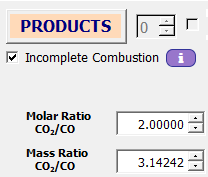
La combustión incompleta se produce cuando no hay suficiente oxígeno para quemar y se produce monóxido de carbono y carbono (hollín), además de dióxido de carbono. La combustión completa, si es posible, produciría solo dióxido de carbono y vapor de agua.
Los productos de combustión en base húmeda:

Los productos de combustión en base seca:

Empleando el diagrama de Ostwald (exceso de aire del 1.10, 8.30% de CO2 y 4.08% de O2).


Al haber compuestos en los productos de combustión que no conforman el estado de referencia de la atmósfera, la aproximación de la exergía del combustible es menos exacta.
Análisis de sensibilidad:


Disociación de los productos de combustión (en situación adiabática):


En condiciones adiabáticas:


En estas condiciones, al aumentar el coeficiente de exceso de aire, disminuye la temperatura adiabática de la llama, con lo que disminuye la constante de equilibrio, disminuyendo con ello la cantidad de NO generado.

El grado de disociación es negativo, es decir la reacción se produce de derecha a izquierda, aumentando el CO~~2~~ y decreciendo el CO.


En condiciones de temperatura de disociación constante:


En estas condiciones, al aumentar el coeficiente de exceso de aire, siendo constante la temperatura del proceso de disociación, con lo que no se altera la constante de equilibrio, habiendo más N2 y por tanto, aumentando la cantidad de NOx generado.
El efecto de la temperatura de disociación, 1500ºC, 1550ºC y 1600 ºC:


La combustión incompleta se produce cuando no hay suficiente oxígeno para quemar y se produce monóxido de carbono y carbono (hollín), además de dióxido de carbono. La combustión completa, si es posible, produciría solo dióxido de carbono y vapor de agua.
Los productos de combustión en base húmeda:

Los productos de combustión en base seca:

Empleando el diagrama de Ostwald (exceso de aire del 1.10, 8.30% de CO2 y 4.08% de O2).


Al haber compuestos en los productos de combustión que no conforman el estado de referencia de la atmósfera, la aproximación de la exergía del combustible es menos exacta.
Análisis de sensibilidad:


Disociación de los productos de combustión (en situación adiabática):


En condiciones adiabáticas:


En estas condiciones, al aumentar el coeficiente de exceso de aire, disminuye la temperatura adiabática de la llama, con lo que disminuye la constante de equilibrio, disminuyendo con ello la cantidad de NO generado.

El grado de disociación es negativo, es decir la reacción se produce de derecha a izquierda, aumentando el CO~~2~~ y decreciendo el CO.


En condiciones de temperatura de disociación constante:


En estas condiciones, al aumentar el coeficiente de exceso de aire, siendo constante la temperatura del proceso de disociación, con lo que no se altera la constante de equilibrio, habiendo más N2 y por tanto, aumentando la cantidad de NOx generado.
El efecto de la temperatura de disociación, 1500ºC, 1550ºC y 1600 ºC:


La combustión incompleta se produce cuando no hay suficiente oxígeno para quemar y se produce monóxido de carbono y carbono (hollín), además de dióxido de carbono. La combustión completa, si es posible, produciría solo dióxido de carbono y vapor de agua.
Los productos de combustión en base húmeda:

Los productos de combustión en base seca:

Empleando el diagrama de Ostwald (exceso de aire del 1.10, 8.30% de CO2 y 4.08% de O2).


Al haber compuestos en los productos de combustión que no conforman el estado de referencia de la atmósfera, la aproximación de la exergía del combustible es menos exacta.
Análisis de sensibilidad:


Disociación de los productos de combustión (en situación adiabática):


En condiciones adiabáticas:


En estas condiciones, al aumentar el coeficiente de exceso de aire, disminuye la temperatura adiabática de la llama, con lo que disminuye la constante de equilibrio, disminuyendo con ello la cantidad de NO generado.

El grado de disociación es negativo, es decir la reacción se produce de derecha a izquierda, aumentando el CO~~2~~ y decreciendo el CO.


En condiciones de temperatura de disociación constante:


En estas condiciones, al aumentar el coeficiente de exceso de aire, siendo constante la temperatura del proceso de disociación, con lo que no se altera la constante de equilibrio, habiendo más N2 y por tanto, aumentando la cantidad de NOx generado.
El efecto de la temperatura de disociación, 1500ºC, 1550ºC y 1600 ºC:
